History of Jameson Whisky: The Irish Icon Every Budapest Visitor Must Know
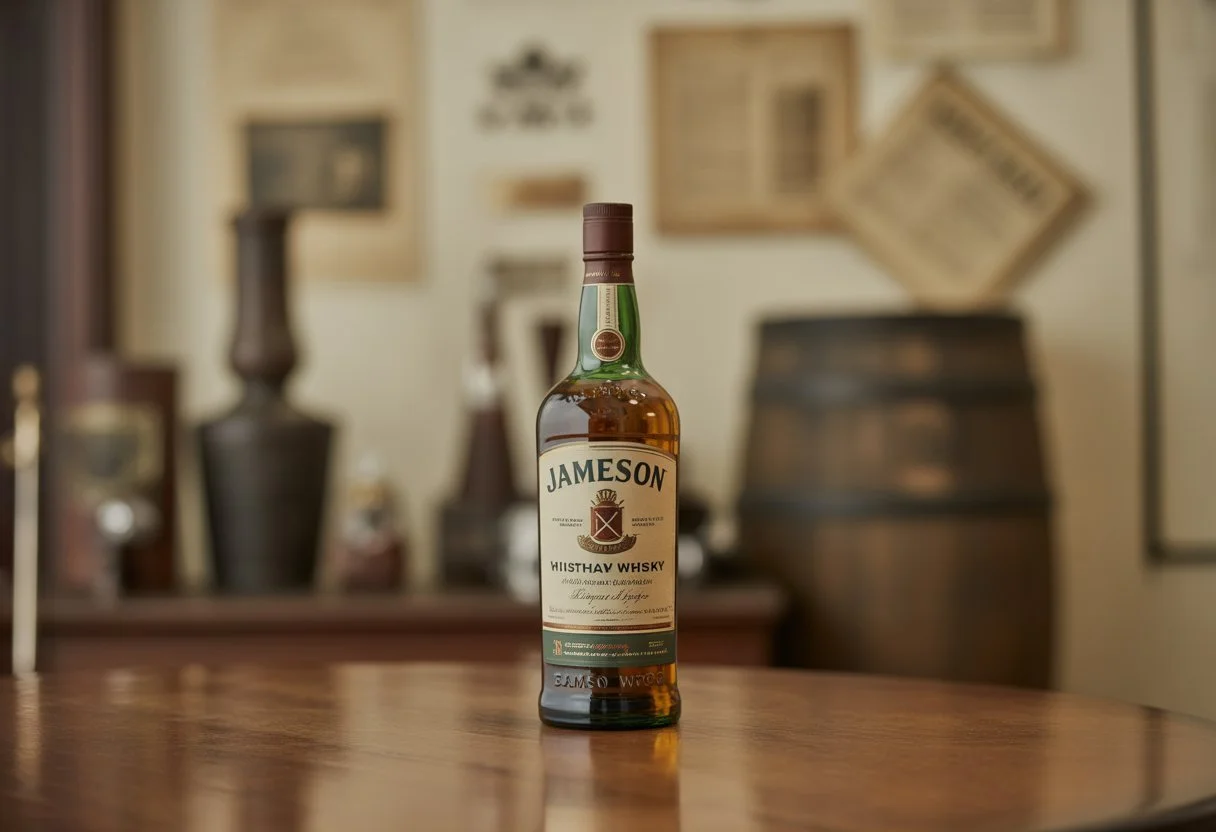
Jameson whisky kicked off in 1780 when John Jameson, a Scottish lawyer, opened his distillery on Bow Street in Dublin. By the late 19th century, Jameson had become the world's number one whisky, producing over 1 million gallons each year from their Dublin distillery.
It's wild to think a Scottish immigrant built an Irish whisky empire that managed to survive wars, prohibition, trade disputes, and the wild swings of the global spirits market.
The journey from a single Dublin distillery to the world's best-selling Irish whisky wasn't exactly smooth. Jameson had to weather the temperance movement in Ireland, lost access to Commonwealth markets during the Irish War of Independence, and got shut out of America during Prohibition while Scottish brands somehow found ways around the ban.
They also faced pressure when Scottish distillers rolled out faster production methods that threatened Irish whisky's more traditional approach. That must've been a tough pill to swallow.
These days, you can still visit the original Bow Street distillery in Dublin—though it's now a museum, not a working distillery. Actual production moved to Midleton in County Cork in 1976, and now Jameson sells over 8 million cases a year across 130 countries.
John Jameson founded his Dublin distillery in 1780, and by 1805 Jameson whisky had become the world's best-selling whisky
The company survived major setbacks including Irish independence, trade wars, and American Prohibition by adapting whilst maintaining traditional pot still production methods
Jameson moved production from Dublin to Midleton in 1976 and now sells over 8 million cases yearly, making it the world's best-selling Irish whisky
Origins of Jameson Whisky
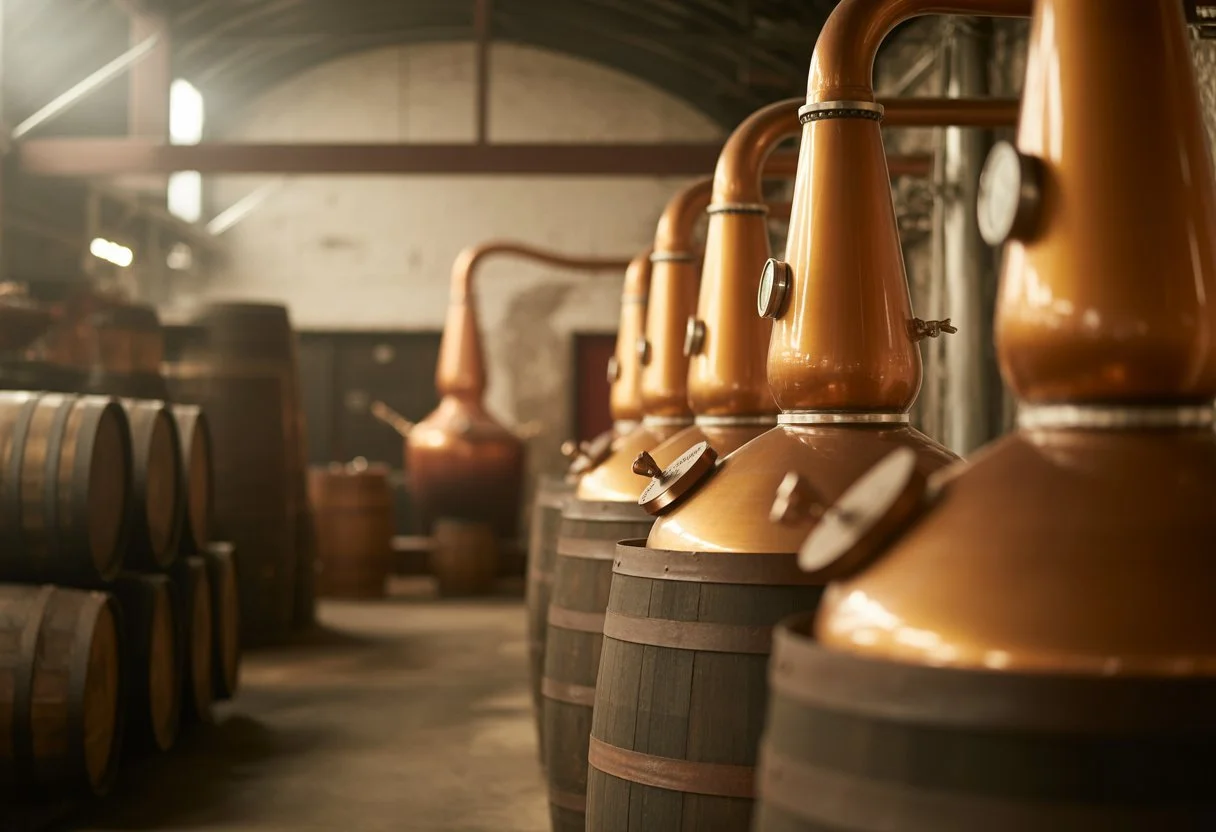
The Jameson story starts with a Scottish-born lawyer who moved to Ireland and married into a distilling dynasty. John Jameson set the foundation for what would become the world's best-selling Irish whiskey in 1780 at Bow Street in Dublin.
John Jameson's Early Life
Born in 1740 in Alloa, Scotland, John Jameson trained as a lawyer before making the gutsy decision to move to Ireland. It's a bit ironic—his Scottish roots, yet he became an Irish icon.
Jameson came from a respectable background, and his legal training gave him business savvy that would prove invaluable in Dublin's competitive distilling scene. Before arriving in Dublin in the late 1770s, he had zero direct connection to whiskey.
Leaving Scotland for Ireland kicked off a family dynasty that would last generations. John Jameson lived to eighty-three, passing away on December 3rd, 1823, after seeing his distillery's early success.
Arrival in Dublin and Bow Street Beginnings
Dublin in 1780 was the second largest city in Britain and Ireland, only behind London. The city had over a hundred breweries and distilleries, so competition was fierce.
The Bow Street distillery was originally set up in 1780 by the Stein family, who hired John Jameson as a manager. Thanks to his work ethic and business sense, Jameson quickly made his mark on the operation.
By the turn of the century, the distillery bore the Jameson name, showing John's growing influence and ownership. Bow Street stayed the spiritual home of Jameson for nearly 200 years, eventually sprawling across almost six acres of Dublin city centre by the 1880s.
The Haig and Jameson Family Connection
Jameson really solidified his place in the whiskey world by marrying into the famous Haig family, well-known distillers in Ireland. That marriage connected two big names in the whiskey trade.
His marriage brought both financial backing and industry know-how, which he definitely needed to compete in Dublin. The Haig connection gave Jameson access to distilling expertise that matched his business chops.
Four of John Jameson's sons joined him in the Irish distilling business, starting a family dynasty that would last for generations. The Jamesons kept control of Bow Street through several generations, with each new John Jameson taking the reins until the 20th century.
The Bow Street Distillery Era
From 1780 on, Bow Street became the heart of Jameson's operations, growing from a modest Dublin distillery into one of the world's largest whiskey producers. This era brought wild growth, technical innovation, and a whole community built around whiskey.
Expansion in 19th Century Dublin
When John Jameson took full ownership of Bow Street in 1805, he kicked off an expansion that reshaped Dublin's Smithfield area. The distillery grew from its original footprint to nearly 6 acres by the 1880s.
By 1870, Bow Street was basically a city within a city, employing hundreds—coopers, carpenters, blacksmiths, painters, stone masons, you name it. The site even absorbed nearby properties, like a piggery yard in 1919 where bacon had once been cured.
Dublin itself was booming, with over a hundred breweries and distilleries all fighting for market share. Whole families worked at Bow Street, with jobs often passed from father to son. People tended to stick around for life.
Innovations in Distillation and Ingredients
Between 1785 and 1825, distillers paid duty on both malt and spirit, which made using malt pricey. John Jameson started experimenting with mash bills using malted and unmalted barley to cut costs and create a flavor profile that set Jameson apart from imported Scotch malt whisky.
The distillery made pot still whiskey using old-school methods, but Jameson kept refining the process. He filled notebooks with mash bills and recipes, making sure each batch stayed consistent.
In 1885, the company launched the Star System to show age on seven-year-old whiskey in certain markets. By 1963, Jameson finally started bottling its own whiskey at Bow Street with Crested Ten, so they could control quality from start to finish.
Life at the Bow Street Site
The distillery really shaped daily life in Smithfield. Its exterior walls radiated heat from the stills, so locals would huddle up to them in winter for warmth.
During the 1916 Easter Rising, a volunteer sniper used the distillery's high ground to watch fighting on North King Street. Luckily, the facility and workforce came through mostly unscathed.
Wartime brought real headaches. A coal shortage in 1918 slowed things down, and corn shortages forced the distillery to close from 1917 to 1918. When restrictions lifted in 1919, Bow Street managed 34 distilling cycles—the most ever at that point.
On June 5th, 1970, the last drops of pot still whiskey flowed at Bow Street, closing nearly 200 years of Dublin production. By 1975, the whole operation had moved to Midleton, County Cork, where all Jameson Irish whiskey gets made now.
The Jameson Family Legacy
The Jameson family ran the whiskey business directly for over 180 years, with five generations steering the distillery through good times and tough ones. Each generation brought something new to the table but kept the core focus on quality and innovation.
Leadership Transitions Through Generations
The Jameson family set up a clear pattern for passing down the business from 1780 to 1966. John Jameson started it all and ran things until 1804, then his son took over. Four of John's sons followed him into Irish distilling, so the dynasty stretched beyond Bow Street alone.
Each handover kept production methods steady while still adapting to new market realities. The family's commitment ran through five Johns—John Jameson I through IV, then Andrew Jameson—before Alexander C Crichton, the last direct descendant, led the company into a 1966 merger. That's 186 years of family leadership, which is honestly pretty wild.
The Role of John Jameson II and III
John Jameson II took charge in 1804 and focused on building on his father's foundation. He kept detailed pocket notebooks with individual mash bills (recipes) for Jameson whiskey, which helped keep things consistent.
John Jameson III took over in 1851 and boosted the family's social standing. He studied at Trinity College and served as Justice of the Peace and High Sheriff of Dublin. His wife Anne lived with him at St Marnock's in Portmarnock, County Dublin.
Under his watch, Bow Street grew a lot, employing hundreds—coopers, carpenters, blacksmiths, painters, stone masons—by 1870.
Notable Family Members and Contributions
Andrew Jameson was one of the family's standout leaders. He held a bunch of positions in local government and even became friends with US President Teddy Roosevelt. The Irish Republic picked him as a Senator in the first Irish Senate, serving alongside poet WB Yeats, who was already a family friend.
Andrew's support of the arts went beyond distilling. The Jameson family also kept strong ties through marriage. John Jameson married Margaret Haig in 1768, daughter of Scottish whisky distiller John Haig, linking two big distilling families. Later generations kept up these industry connections, with John Jameson IV marrying twice—to Elizabeth Banfield and Mary Haig—but having no kids to carry on his direct line.
Challenges and Triumphs in the 20th Century
The 20th century really put Jameson's resilience to the test with political upheaval, trade restrictions, and market collapse. The distillery had to deal with the Irish War of Independence, American Prohibition, and trade wars that nearly wiped out Irish whiskey.
Impact of the Irish War of Independence
The Irish War of Independence from 1919 to 1921 threw a wrench into Jameson's operations and exports. The conflict made it hard to keep production steady and get whiskey out to international markets.
After Ireland gained independence from Britain, the new political scene brought unexpected headaches. Trade relationships Irish distillers had built over decades suddenly became complicated. Jameson faced more scrutiny and trouble exporting to Britain and Commonwealth countries—markets they'd long relied on.
The distillery's Dublin location put it right in the middle of political tensions. Being so close to the action made daily operations and keeping the workforce stable a real challenge.
Prohibition and International Markets
American Prohibition from 1920 to 1933 cut Jameson off from its biggest export market. The United States had been their main destination, so losing American consumers meant a massive hit to revenue.
Illegal smuggling kept some whiskey flowing, but it couldn't replace real, legitimate trade. Bootleggers sold fake "Irish whiskey" that hurt the reputation of the real stuff—no way to check quality or protect the brand when everything's under the table.
When Prohibition ended in 1933, Jameson struggled to win back market share. Scottish whisky makers had already set themselves up for the American market's reopening, grabbing advantages that stuck around for decades.
Trade Wars and Industry Decline
The Anglo-Irish Trade War from 1932 to 1938 slapped heavy tariffs on Irish exports to Britain. Britain was Ireland's closest trading partner, so these restrictions hit Jameson's ability to sell whiskey in this crucial market hard.
Irish distillers faced economic barriers that made their spirits uncompetitive. By the 1960s, the Irish whiskey industry had basically collapsed.
Only a handful of distilleries kept their doors open where dozens once thrived. Jameson ended up merging with Cork Distillers and John Powers in 1966, forming the Irish Distillers Group—a move that felt pretty necessary just to survive.
The company shifted production to the New Midleton Distillery in County Cork in 1976. That modernization let Jameson boost efficiency and, eventually, grow into the best-selling Irish whiskey on the planet.
The Move to Midleton and the Modern Era
The 1960s shook up Irish whiskey production. Struggling Dublin distilleries merged and eventually moved to County Cork.
This big change saved Jameson from disappearing and set up Midleton as the heart of Irish whiskey for decades. It’s wild to think how close they came to fading out.
Formation of Irish Distillers Group
In 1966, three major Irish whiskey companies teamed up to form Irish Distillers. John Jameson & Son joined forces with John Power & Son and the Cork Distilleries Company.
This merger happened right when Irish whiskey was getting hammered by cheaper Scotch and changing consumer tastes. Powers and Jameson both ran distilleries in Dublin, while the Cork Distilleries Company owned Midleton Distillery.
Pooling their resources and knowledge gave these historic brands a fighting chance. The new company tried to keep separate production sites at first, but the Dublin distilleries just didn’t have the space or modern equipment for large-scale upgrades.
Relocation to County Cork
Irish Distillers built the New Midleton Distillery in 1975, right next to the old one that had been running since 1825. The new facility let them bring production of Jameson, Powers, and other brands under one roof.
This move completely changed how Irish whiskey got made. Suddenly, you could produce different whiskey styles in a single place using high-tech equipment.
The distillery uses both copper pot stills and column stills, so they can make traditional pot still whiskey and grain whiskey side by side. The old Jameson distillery in Dublin’s Bow Street stopped production, but now serves as the Jameson Distillery Bow St visitor centre.
Innovation and Expansion in Recent Decades
Pernod Ricard bought Irish Distillers in 1988, bringing in the cash needed for global growth. With this backing, Jameson transformed from a struggling brand into one of the world’s top five whiskey brands by sales.
By 2022, the brand shipped 10.4 million cases. Midleton now makes seven whiskey brands, including Jameson, Powers, Redbreast, Spot Whiskey, and Midleton Very Rare.
The distillery runs over 160 maturation warehouses, holding more than 2 million casks. That’s more than all the other whiskey casks maturing in Ireland combined.
The site just keeps growing. Irish Distillers is building a third Midleton Distillery on a 55-acre spot next to the current facility—a €250 million project that’ll boost capacity and run as a carbon-neutral operation.
Jameson Whisky Today: Global Influence and Visitor Experience
Jameson Irish Whiskey holds its spot as the world’s best-selling Irish whiskey, now found in over 130 countries. The brand keeps its heritage alive through the Bow Street visitor centre, while every drop of Jameson gets made at the Midleton Distillery in County Cork.
The Jameson Distillery Bow St. Visitor Centre
The Old Jameson Distillery at Bow Street reopened as a visitor centre in 1997. After an €11 million revamp in 2017, it became the world’s most visited whiskey experience, pulling in over 350,000 visitors in its first year.
The guided tour takes you through close to 240 years of whiskey-making history. You’ll walk the original buildings where production stopped in 1970 and get a look at the triple distillation process that makes Jameson unique.
Tastings let you compare Irish whiskey with Scotch and American styles. In 2018, Jameson Distillery Bow St. won the "World's Leading Distillery Tour" award at the World Travel Awards.
The centre includes JJ’s Bar, where you can sample exclusive pours like Crested whiskey. Tours run daily, but you’ll want to book ahead during busy seasons.
Popular Expressions and Product Range
Jameson offers more than just its standard blend. Jameson Caskmates finishes whiskey in craft beer barrels, giving it some really unique flavors.
The Stout Edition uses barrels that held Irish stout, while the IPA Edition gets its finish from India Pale Ale casks. Jameson 18-Year sits at the premium end—a limited edition blend of pot still and grain whiskeys aged in oak for nearly twenty years.
Other standouts include Jameson Black Barrel and Crested, the first whiskey bottled at Bow Street in 1963. All Jameson whiskeys are Irish blends, mixing malted and unmalted barley.
The brand produces over 5.4 million cases a year at Midleton, keeping its lead in the category. Not bad for a whiskey that almost vanished a few generations ago.
Jameson in Cocktails and Popular Culture
Jameson Irish Whiskey shows up in tons of classic cocktails. The whiskey sour blends Jameson, lemon juice, sugar, and egg white for a drink that's smooth and surprisingly balanced.
Irish coffee? That's Jameson with hot coffee, brown sugar, and cream. It's a cozy classic, especially on chilly evenings.
Bartenders all over the world reach for Jameson because it just works in mixed drinks. Its smooth profile shines in highballs, old fashioneds, and all sorts of modern craft cocktails.
People love the easy mixes—Jameson and ginger ale or Jameson and cola are everywhere. They're simple, but somehow never boring.
The brand pops up at music festivals and cultural events across the globe. Jameson actually sponsors live music venues and jumps in to support new artists through different programs.
All that cultural energy? It pulls Jameson out of the old-school whiskey crowd and into the playlists of younger folks who want something real.
